Artfully Curated

Painting the Spaces In Between

Letting paint move before deciding where it should land is central to Helen Jayne Woodcock’s practice.

Here, she discusses working between control and freedom, how weather becomes a narrative tool, and what it means to know when a painting has finally come to rest.

Your paintings often feel like moments just before or just after something happens. Are you more drawn to beginnings, endings, or the spaces in between?

The spaces in between. I like taking a visual slice of life from within a wider scene and focusing on that — a moment where things feel paused or quietly changing. It might be the light shifting, weather rolling in, or the calm just after something’s happened. Those moments feel familiar and lived-in, and they’re often the ones people recognise without quite knowing why.

You allow paint to move freely before refining it into recognisable scenes. How much do you trust the paint to lead you—and when do you step back in?

I trust the paint a lot at the beginning, and that’s the part I really love. Letting it move freely creates energy and marks I couldn’t plan. I also enjoy knowing there’s a loose, expressive painting underneath everything. At a certain point I step back in, refine, and make decisions — shaping what’s there rather than forcing something new.

Weather plays a quiet but powerful role in your work. Is there a particular kind of weather that feels most like ‘home’ to you on canvas?

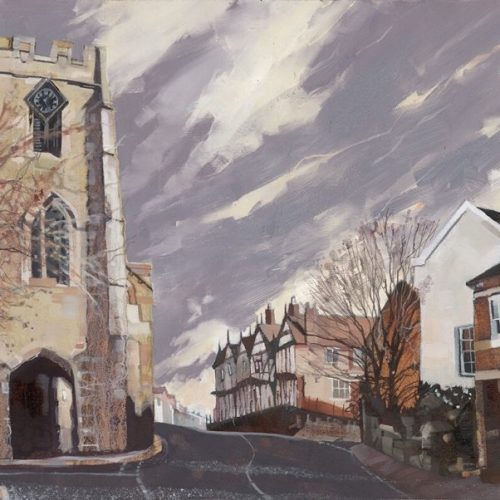
Skies and weather are everything to me. I’m quite happy to get wet, or to be out early for a winter sunrise when the trees are bare and you can see colour threading through the branches. I like using nature to soften city scenes when I can — hopeful trees, ivy on brickwork, moss on stone. Rain and snow have become tools for me, ways of telling the story of a day just as much as sunshine and shadow.

Coming from graphic design and illustration, clarity and control are part of your visual DNA. What did fine art give you permission to loosen?

Graphic design gave me a strong work ethic, and I still rely on that. If a painting starts to get away from me, I’ll dig in and resolve it, trusting the processes I’ve learned over time. Composition, too, is closely linked — on some level a painting is still about arranging an image so it has purpose and holds attention, even if only for one viewer.

Your landscapes feel tranquil, but never static. How do you keep a sense of movement without disturbing the calm?

I often work in panoramic formats, which helps. It allows a gentle shift from one mood to another across the painting— storm to calm, sunset to dusk. Movement comes from tonal changes, softened edges and layered marks, rather than anything obvious or busy. I want the eye to travel naturally, without being pushed.

You paint places you know and places you visit. What tells you a scene is worth returning to in paint, rather than simply remembering?

If I catch myself wanting to look again. That might mean walking backwards so I don’t miss a view, or even chancingtraffic to grab the centre of a street scene. If a place makes me slow down or take a risk just to see it properly, it’s probably worth returning to in paint.

Texture is central to your work, yet it often recedes quietly into the image. Do you think of texture as something to be seen, or something to be felt?

Felt. Texture is my chance to experiment as a painting develops — little pops of its history showing through. I don’t want it to shout, but I do want it to add depth and physical presence, even if the viewer only senses it rather than notices it outright.

You refine flowing paint into recognisable forms. Is that process more like listening, editing, or translating?

Editing. The paint says a lot very quickly, and my role is to decide what to keep, what to lose, and what needs
clarifying.

Your work invites viewers to slow down. Was creating tranquillity a conscious goal?

It emerged naturally. Waiting for textures to develop physically forces me to slow down, and I think that carries through to the viewer. When someone moves in close to a painting, I hope it encourages the same pause and quiet.

If your paintings had a pace, would it be?

They can be swift. I often have two or three paintings on the go at once, especially if they share a similar feel. I like being fully immersed in the scenery — sometimes the studio feels quite crowded with places, but in a good way.

You work across landscapes, seascapes, cityscapes—and occasionally portraits. What changes in your mindset when the subject changes?

Landscapes and seascapes are about space, light and distance. Cityscapes bring in structure and rhythm. Portraits require a much more focused, personal attention. The process stays consistent, but the emphasis shifts.

Many of your scenes feel familiar, even to people who have never been there. How important is shared memory in your work?

Shared memory matters a lot. People have often said they feel they’ve walked through my paintings — places that feel familiar, even though they’ve never stopped to really look at them before. If my work makes someone look again, that feels important.

As someone who welcomes commissions, how do you balance another person’s vision with your own instinct and atmosphere?

I have to trust that someone has chosen me because they like how I handle paint. That can feel like a responsibility, especially with more complicated commissions — and I’ve had a few. Keeping confidence in my own style is key; it’s what allows the painting to feel genuine rather than forced.

How do you know when a painting has reached its point of rest?

I’ll often hide a painting away for a few days, then come back to it. If what was bothering me before no longer feels like a problem, I’m happy to call it finished. I’m usually keen to move on to the next one — I’m always learning, and that sense of development never really stops.

error: Content is protected !!