Finding Stillness in the Everyday
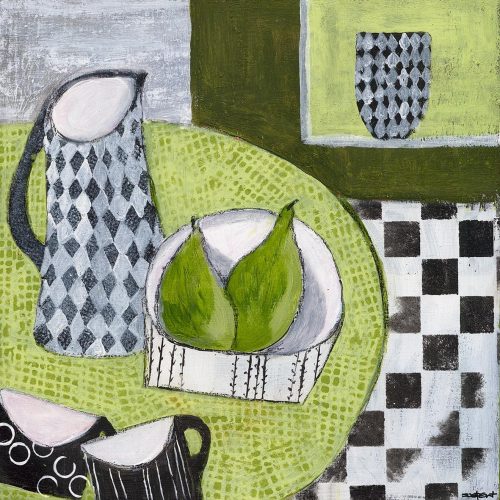
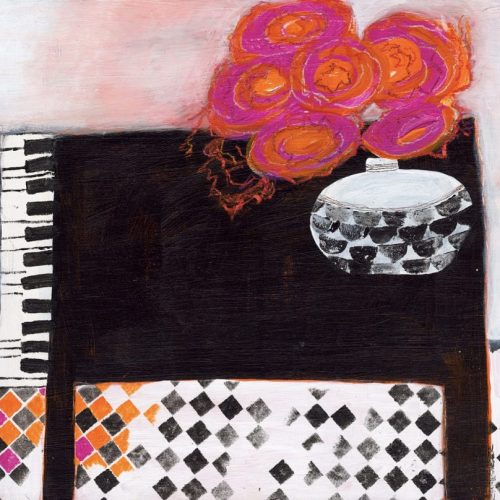
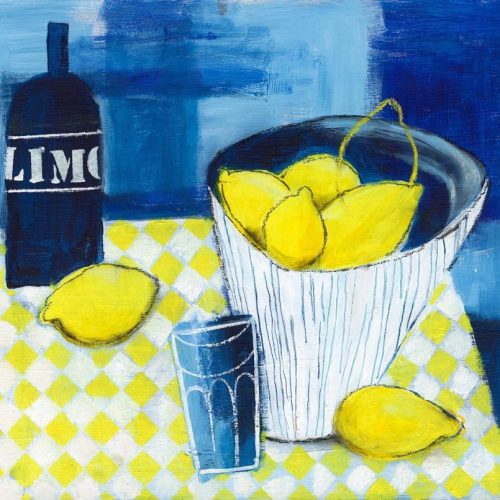
Step into the quiet, attentive world of Sue Bent and you’ll find yourself surrounded by familiar things seen anew. A jug tilts slightly, fruit settles into place, garden flowers pause at the edge of bloom—ordinary objects charged with memory, colour, and care.
Working from her garden studio, Sue’s still lifes are less about description than feeling. Coloured inks move freely across the page, allowed to react and dance, while forms remain intentionally open and unresolved. The result is work that feels both grounded and generous: images that invite the viewer to slow down, fill in the gaps, and find comfort in the small, domestic moments that quietly hold us together.
Having spent much of your professional life working with structure and responsibility, what does making art allow you to unlearn?
I’ve learned that art does involve process and my practice improves when I apply the processes I’ve learned. What I love though is that there are no rules. The areas of law that I worked in were ones where lawyers are testing the boundaries of the law. I loved the creativity involved in that and it translates across into art.
You’ve moved between worlds that value certainty and worlds that thrive on ambiguity. How comfortable are you with not knowing where a painting will end when you begin?
That’s a work in progress! I do have an idea about where I’d like a work to go when I begin, but I’m learning that that is restrictive. There’s a lot of action and reaction involved during the making of art — and actually that’s not dissimilar to the legal world!
In law, precision matters enormously. In your artwork, where do you consciously allow things to be imprecise or unresolved?
The art I love most is where the artist has left room for my brain to fill in the gaps. I’m consciously trying to adopt that style in my work to allow the viewer to interact with it.
Still life can feel modest and inward-looking. Do you see that choice as a counterbalance to a life spent in high-responsibility roles?
That’s an interesting question that I haven’t thought about! I do like the contained nature of still life and I try to express the feeling of ‘nesting’ I get when I’m at home. So I suppose it is about trying to portray the security my home has always given me, especially when times were tough at work.
You work with everyday objects—jugs, fruit, garden flowers. What do ordinary things give you that grand subjects wouldn’t?
I’ve always loved homes. I like to imagine the inside of houses I walk past and I love looking in when the lights are on in the evening. Everyday life is fascinating to me and I’m very lucky that my home is somewhere I love to be, where I feel safe and relaxed. The objects I have in my home give me endless joy; this includes pieces I’ve bought or collected and which I frequently rearrange, as well as the sense of home that comes from ordinary objects like cooking utensils. So, I relate to everyday objects and the resonance of home that they have.
Your studio is a hidden garden shed—does that sense of secrecy change how freely you make work?
My shed is my happy place. It’s only ever used to make art and I can feel my shoulders drop when I go into it. It’s made of wood, and just the smell of the wood when I open the door makes me happy. My garden is a bit wild and out of control but it’s full of birds and so it feels a world away from the streets outside.
Flowers and fruit are familiar subjects, yet your colours make them feel freshly alive. What does colour allow you to say that drawing alone can’t?
Colour is everything! I choose colours before subject matter. You will find the colours I love to paint with in my home and in my clothes. I think everyone should paint with colours they love.
Coloured inks have a mind of their own. Do you feel more like you’re guiding them—or letting them dance?
Absolutely letting them dance! The reason I love coloured inks is because they can’t really be controlled. The different pigments react with each other and push the colours around the paper. That’s where the magic happens and that’s what keeps the colours fresh and vibrant.
Still life is often associated with quiet observation. What do you look for before you decide something is worth painting?
I select flowers and fruit that will allow the coloured inks to show off. I look at shapes and often the spaces between them. The objects in my still life works are usually ceramics I’ve collected so they feel like old friends.
Do you arrange your still life compositions carefully, or do you respond to what’s already there in front of you?
I actually paint most of my still life work from memory. I don’t want the images to be too representational and I find if I work from memory I get a looser, less detailed outcome.
When you’re working alone in your shed, what tells you to stop—a finished image, a feeling, or the moment before you overwork it?
Coloured inks, like watercolours, really only offer one chance. I also paint in acrylic and in those paintings there is room for endless reworking and covering up and repainting. Coloured inks are translucent so every mark that you make can be seen. That makes it easier to stop. I quite frequently don’t like my work immediately though, and so I usually put it away — and then I often like it a week later when I bring it out again.
You’ve supported many artists through your work as a trustee and art room manager. Has witnessing other people’s creative struggles changed how patient you are with your own?
Being part of Leamington Studio Artists has been amazing! I’ve learned that very many artists lack confidence in their work. I regularly meet people who struggle to actually describe themselves as an artist even though everyone else would think they are, and their work is great. So I’ve learned that self-doubt seems to be a condition that’s common for many of us. I try hard to give support and encouragement to others because I know what it feels like.
If your paintings could offer one small gift to the viewer, what would you hope it was?
I hope my work makes people smile and I hope it brings some cheer into a corner in their home if they choose to buy it.